Friday, 5 April 2013

Andrea Stuart's Sugar in the Blood


As reviewed in the New York Times, "Masters and Slaves," by Andrea Stuart, on 29 March 2013  --  On a trip to Paris, I recently had the same shocked realization that Andrea Stuart describes in her astounding new book, “Sugar in the Blood.”

Slaves built this, I thought as I wandered from one grand 18th-century monument to the next. How rarely we acknowledge that Europe’s great cities were built on profits from the labor and blood of slaves cutting sugarcane half a world away.

Sugar in the Blood: A Family's Story of Slavery and Empire; by Andrea Stuart

Stuart, a London-based author of Barbadian ancestry, writes of contemporary England: “Sugar surrounds me here.” The majestic Harewood House in Leeds was built with money from Caribbean sugar plantations, she points out, as was the Codrington Library of All Souls College in Oxford and Bristol’s mansions. The slaves of the West Indies built this wealth while unaware of its existence, or of their own connection to it. Without them, the vast empire that gave the world Victoria and Dickens might never have existed.

In this multigenerational, minutely researched history, Stuart teases out these connections. She sets out to understand her family’s genealogy, hoping to explain the mysteries that often surround Caribbean family histories and to elucidate more important cultural and historic themes and events: the psychological after­effects of slavery and the long relationship between sugar — “white gold” — and forced labor.
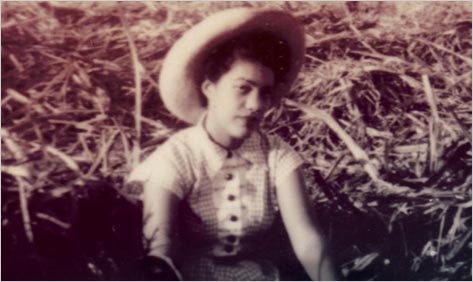

“Sugar in the Blood” begins in the late 1630s with Stuart’s maternal ancestor George Ashby, a young blacksmith in England, preparing for his voyage to the Americas. He was “most likely typical of the men who settled much of the New World, a man of action, not reflection, who did not take time out to write letters or keep journals,” Stuart writes, and she relies on historians and other personal accounts to flesh out his motivations, his reasons for migration and the “assault of newness” that was Barbados.

“As a Northern European, George Ashby was used to a palette permanently tinged with gray; here, the world was suffused with light and brightness. . . . The night was different here: the constellations disordered, the stars brighter and more prolific above him. The smell of the tropics was also novel: the intense perfume of flowers and spices mingled with the salty sea air and the warm fermenting smell of the earth.”


Much of the fiery magic of this book arises from Stuart’s ability to knit together her imaginative speculations with family research, secondary sources and the work of historians of the region, including C. L. R. James and Adam Hoch­schild. Stuart spins this rich material into a colorful and complicated narrative from Ashby’s arrival in Barbados in the 1630s up to 1835, a year after Britain abolished slavery, always attentive to the continuing repercussions of the plantation system in the United States and the Caribbean.

The book is full of wonderful characters. The early islands were awash with pirates, buccaneers, reprobates, criminals and the dissolute, depraved, discarded refuse of the motherland. Often these ruffians rose to high position in the New World — like Capt. Henry Hawley, known as the belligerent, “fire-eating” governor of Barbados, who had his predecessor executed and sold land to new arrivals. At a meeting with the daunting Hawley, ancestor Ashby acquired the original nine acres that eventually grew to a 350-acre sugar plantation where some 200 slaves labored.
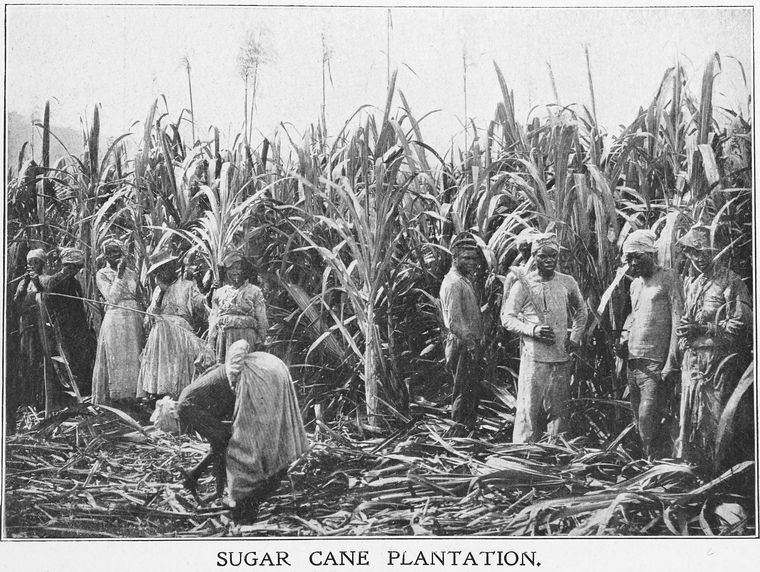

Stuart also presents a full portrait of George’s descendant, the hard-nosed plantocrat Robert Cooper Ashby, who took over the plantation in 1795. We learn about his thorny relationship with his wife, Mary Burke, and with his many slave “concubines,” notably Sukey Ann, with whom he had four children and whom he finally freed just before abolition. We also learn much about the hard business of sugar cultivation.

One of the many pleasures of “Sugar in the Blood” is its author’s evocation of everyday life on the plantation. In one section, Stuart describes a day on the Ashby holdings (called Burkes, because most of Robert Cooper’s land came to him through his wife). This day is presented first from the detailed perspective of the planter and his family and then from the more broadly painted point of view of the slaves, who left little historical record of their presence, except when they were bought or sold.


It is easy, Stuart writes, to imagine the Ashby family “slumbering on canopied beds piled lushly with cushions and covered with embroidered sheets, as the ubiquitous bats soared and dipped against the starlit night and the plantation dogs barked their messages to their neighbors; or gorging on lavish plantation meals; or sitting on the balcony’s wicker furniture enjoying their lime water; or playing backgammon on the patio; or strolling in the garden against a backdrop of green pastures and a vivid sky, while the sounds of the slaves cutting cane wafted over to them from the far-off fields.” In the mornings, Robert Cooper Ashby would be awakened by his “body slave” (a dreadful term to add to the long lexicon of slavery), who would bathe, dry and dress his master and fix his hair. Ashby would descend to a breakfast that might include, as a visitor described it, “a dish of tea, another of coffee, a bumper of claret, another large one of hock negus; then Madeira, sangaree, hot and cold meat, stews and fries, hot and cold fish, pickled and plain, peppers, ginger sweetmeats, acid fruit, sweet jellies.” “It was a point of honor in plantation society that no menial activity was undertaken by anyone but a slave,” Stuart writes. ­“Cooper and his contemporaries would do as little for themselves as was humanly possible.” At night the body slave held the chamber pot for the master.

Meanwhile, the slaves were “woken before sunup by the clamoring sound of the bell atop the mill.” They “hauled themselves off the floors of their fetid huts and quickly splashed their faces with cold water before being led to the cane fields by the overseer.” They worked until 9 o’clock, when they were allowed half an hour to eat a bit of boiled yam or plantain. And back to work, with a midday break, until sundown or later. Upon returning to their quarters, they had “children to attend to, homes to be cleaned, allotments to be tended and food to be cooked.” During harvest, field hands frequently worked through the night. “More than one observer compared the scenes in the sugar mills to Dante’s inferno,” Stuart writes. “Near-naked slaves labored in the glow of the flames and the roaring noise and the ferocious heat of the boiler room.” Slaves worked up to 18 hours a day. Accidents were so common an ax was kept handy to slice off limbs caught in machinery.
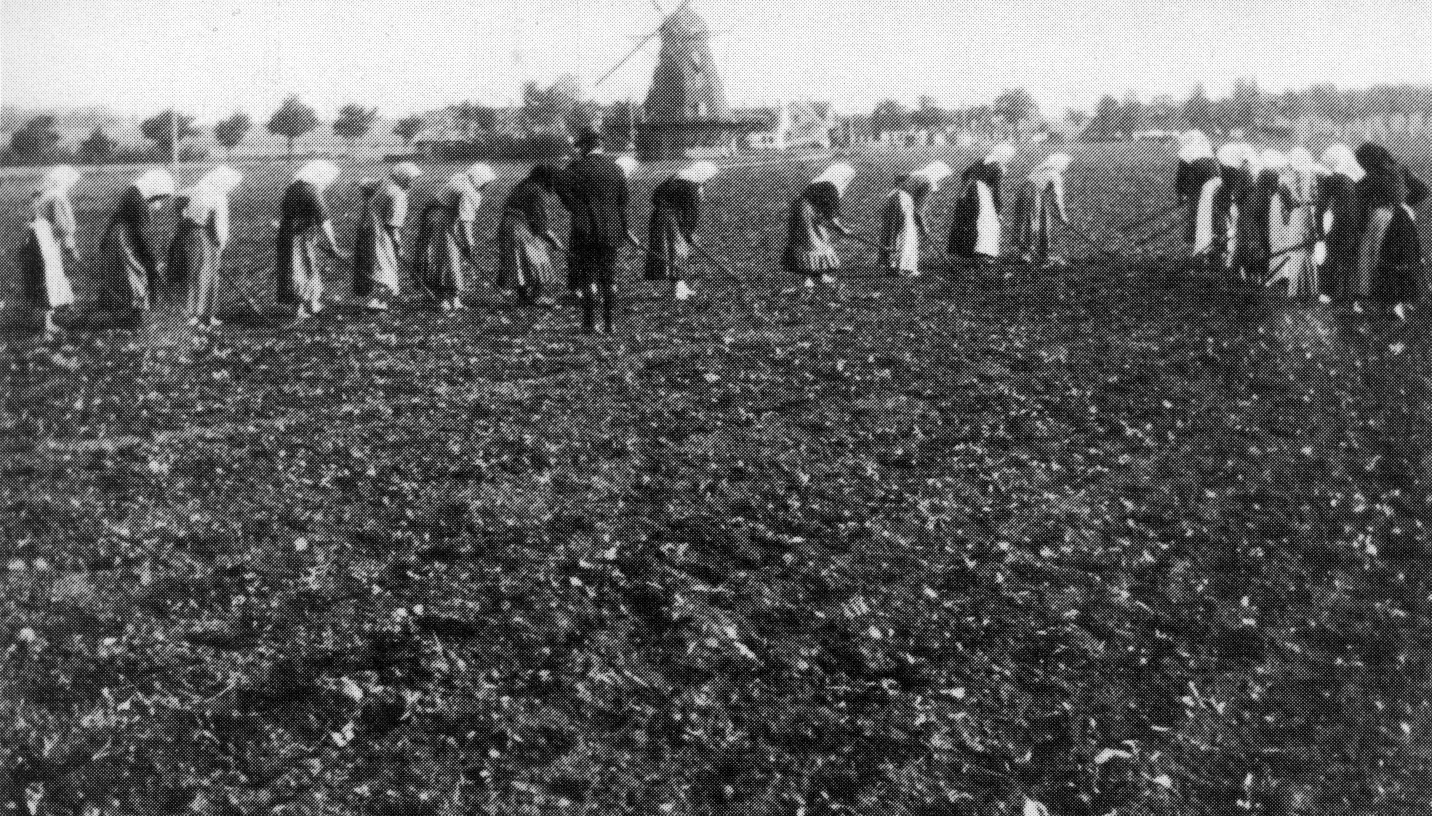

But the book’s importance consists not only in such vivid and specific retellings but in how it explains the mentality of the masters alongside the predicament of the slaves.

Stuart feels complicit in both sides of the story she is telling. If Robert Cooper Ashby was her forebear, so was his concubine, the “unknown female (slave)” who gave birth to John Stephen Ashby, Stuart’s mother’s great-great-grandfather, of whom almost no record exists. She understands the white master and his cruelties, she understands the slave in her misery, and she understands the thwarted attempts of both to recapture their humanity. As Frederick Douglass said, “No man puts a chain about the ankle of his fellow man without at last finding the other end fastened about his own neck.” Stuart also illustrates how the exigencies of the sugar trade stand squarely in the middle of the suffering and moral confusion.

There is not a single boring page in this book, which — as a longtime reader of nonfiction and skipper of boring pages — I can attest is an achievement in itself. In every chapter of “Sugar in the Blood,” history, fact, analysis and personal reflection combine to move the narrative forward, both the grand story of slavery and sugar and the more mundane but always fascinating story of family and business. And beneath every banal moment of cooking or cleaning, of selling or buying, of dressing or undressing, the threat of uprising and rebellion beats loudly, as it must have done on the plantation.


Again and again, Stuart shows us the costs of what the historian Edward Brathwaite called “social processing,” in which white newcomers who were initially horrified by slavery began to accept its strictures and harshness. She quotes Lt. Thomas Howard, who served in the Caribbean in the 1790s: “When I first came into this Country . . . every time I heard the Lash sound over the Back of a Negro my very Blood boiled and I was ready to take the whip and the Lash of the Master. Since that time . . . I am persuaded my heart is not grown harder . . . yet I see the Business in a very different Light.”

Howard had come to understand that violence was critical to the plantation economy. Without it the inequalities and inequity demanded by large-scale sugar cultivation could never be maintained. Stuart disproves the “kind master” and “docile slave” stereotypes; every person she describes, whether slave, master or the wide cast of those “in between,” was trying to grab at whatever possibilities or luck might emerge from the inhumane system.


“Sugar in the Blood” brings us into the present day. The mill tower at Burkes plantation where the bell was rung calling the slaves to the cane is now the studio of a local artist who has built a “fashionable home beside it.” The master’s grounds at Plumgrove, a part of the Ashby family holdings where Stuart spent many childhood summers, is a housing development, and soon the great house will be turned into condos.

There may be liberty, equality and condominiums now, but slavery’s legacies continue. In many places in the Caribbean, skin color still counts, and the lighter — or brighter, as it is said — the better. Darker-skinned people, descendants of the slaves, still toil in unrewarding work, as chambermaids in tourist hotels along the beaches of Barbados, say, or in garment factories in Haiti — when they are lucky. And the lighter-skinned elite, descendants of master and slave, still function as a kind of aristocracy. Stuart is one of them, and with this powerful book she explains how she herself arrived in the complicated Caribbean, and she analyzes and, crucially, humanizes its conflicted, confounding legacy. [source: The New York Times; Amy Wilentz is the author, most recently, of “Farewell, Fred Voodoo: A Letter From Haiti.”]


Thursday, 4 April 2013

TRANSLATED GERMAN: TRANSATLANTIC TRADE


"The slaves Transporter: The Trans-Atlantic triangular trade,"  on 13 OCTOBER 2008, armin fischer / mare

UNTIL WELL INTO THE 19TH CENTURY EUROPEAN SLAVE TRADERS SHIPPED TENS OF MILLIONS OF BLACKS IN THE CARIBBEAN. BEHIND THIS WAS EUROPE'S APPETITE FOR SUGAR

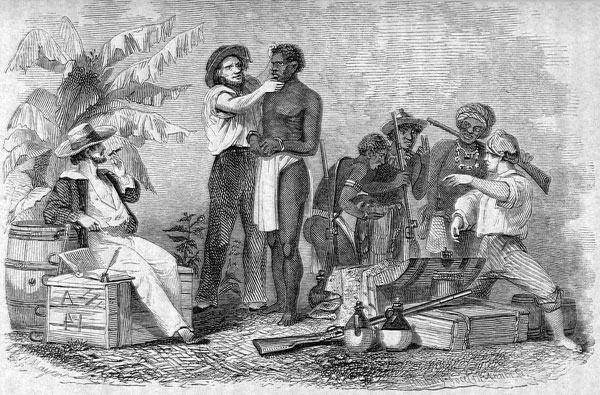
At the beginning of the 19th Century saw a London company, the medical equipment sales, an unusual increase in demand for an instrument called "speculum oris" (mouth area). The metal spreader served doctors to open up a jaw cramp the patient's mouth by force - a brute therapy that has been used only rarely. Emerged as the leader of the serious Londones trading house of the matter on the ground, he came upon a dingy Liverpool shop, next to the window of thumb screws, hand and ankle cuffs and the chin retractor was - all equipment for slave ships: prisoners blacks who would rather die of hunger , enslaved and deported as was to be, with the "speculum oris" brutal levered the mouth to infuse them with food.

Had at that time, trade with African workers abducted long ago evolved into a veritable industry - therefore great need for torture and toggle tools, the minions of the slave traders.

THE TRADE IN KIDNAPPED BLACKS WAS AN INDUSTRY

250 years before the mass had begun to Menschenschinderei strange way, namely with the fact that a person wanted to save others from their drudgery: In the year 1514 was the Father Bartolome de Las Casas, a piece of land in the Spanish colony of Cuba is about. Land belonged to the indigenous Carib Indians around 100, which were held as slaves and forced to work on the plantations. As Las Casas realized how much suffering the Indians in their forced labor, and when he saw how many died as a result of disease and suicide, he suggested to his king, Charles V, Negro slaves who were considered to be docile and willing workers, for work introduce into the colonies. - This was the starting point for the transatlantic slave trade.

Las Casas, who had initially been just about the equality of the Caribbean Indians suspected (yet) had, he unleashed the avalanche. Later, when he saw what he had done, he went back to Spain and started a nationwide campaign against the slave trade - without success. Slavery had found a new territory and it should not give up so quickly again.

A LIFE WITHOUT SLAVES WAS SOON NO LONGER IMAGINE

The colonists in South America and the Caribbean islands soon realized how much could they use the black slaves in the hard work under the unbarmherigen tropical sun, especially since most of them, from the African west coast (primarily from Sierre Leone, the Gold Coast , from Benin, Ghana and Angola) came, thanks to their innate sickle cell anemia against the rampant everywhere were resistant malaria. Soon were the conquerors of the Old World, a life without slaves no longer present. Finally, they were not drawn into the distance, in order to toil, no, they wanted to get rich quick, to live a comfortable life and let others work for themselves.

In the second half of the 16th Century, when the sugarcane cultivation began to expand on the islands, was the demand for slaves and more pressing. Instead of domestic slaves, mistresses, errand boys, and gardeners now have a different kind of "merchandise" was asked of pure slave labor for the grueling grind the sugar cane fields. Sun promoted above all the (European) demand for sugar, which was then a gold aufzuwiegendes luxury item, the deportation of millions of blacks.

IT WAS A GREAT HISTORICAL STEP BACKWARDS

Historically, this act of mass rape meant a step back in time to 1000 years. Because in Europe, slavery had long since replaced by the system of serfdom. The serfs, who were indeed "subject" and their masters, but they had freedoms that were unthinkable for slaves: they were a separate piece of farm marry country, carrying out a "private life" - all of course depending on the generosity and kindness of Lords . However, slaves were simply a "possession" as some nice boots or ox. They were given away, sold, raped, beaten, - no one cared about. It must be up to the time of the Roman latifundia go back to find a similar form of mass slavery, as from 16 Century by the "modern" nations of Europe was re-operated. And the number of Caribbean sugar and later cotton slave exceeded U.S. since ancient times for the first time those two million working slaves, who was one of the Roman Empire 100 BC. Transatlantic slavery was a "monstrous aberration in the history of the West" (H. Hobhouse). The number of Africans who were abducted over the centuries, the sea is difficult to estimate, it is about 20 million, only about 15 million living reached the goal.

END OF THE 16TH CENTURY INCREASED THE DEMAND FOR SUGAR CONTINUES

In 1510 there were only a handful of sugar cane plantations on the Caribbean islands. 50 years later there were hundreds and sugar exports to Europe began. Another 50 years later, the Caribbean, the main producer and exporter of European sugar. And after dieTürken the traditional producing countries Cyprus, Crete and the North African coastal countries and occupied most of the Mediterranean sugar industry was destroyed, was for the commercial centers of the Old World Caribbean sugar not only welcome, no, he had suddenly become necessary. It increased at the end of the 16th Century is, could the demand continuously and the producers hardly meet her.

Hardly a plant was then won so labor intensive, such as sugar cane. The plant was monotonous manual labor, the harvesting of muscle-sapping drudgery. When boiling the plants in the "sugar house" caused temperatures of 60 degrees, which the workers were exposed for hours without a break. The plantation owners were suffering under permanent labor shortages. Supply of new slaves had to constantly ago.

Unscrupulous traders recognized early on that there was merit in these times with the trade of black workers to a lot more money than if you had to work for the slaves themselves. Originally, the black slaves from the European hub Lisbon had been shipped to the New World. (Although most Europeans were once nothing more than a chimera idea of ​​the continent of Africa, there was already a thriving Negro slave market - served by pirates and Arab merchants.) But that was not enough anymore. By 1530 they sent the first slaves directly from Africa to the Caribbean - the incipient triangular trade between Europe, the West African coast and the Caribbean islands of slavery gave a new dimension.
AROUND THE YEAR 1530 BEGAN THE TRIANGULAR TRADE

This business was as follows: predominantly English, Spanish and French ships brought inferior goods to West Africa, often coarse cloth, iron goods and alcohol, sometimes firearms, gunpowder and ammunition, which they exchanged with native slave-traders against "living goods". Often, local chiefs were spurred on to wage war against other tribes, but to make prisoners, who were then enslaved. When the ship was finally crammed with slaves in chains down - sometimes 600 or more, it stood out to sea across the Atlantic. After six to eight weeks, the Caribbean ports and reached the slaves were sold one by one. Major trading centers were Port Royal and Kingston, Jamaica. If the living cargo was on board, conceived the ships rum, molasses and crude, refined sugar, and once entered, favored by the prevailing westerly winds, the trip home.

The traders made enormous profits. In the early days of the triangular trade a male slave on the African Gold Coast for 2 to 3 pounds could be bought - equivalent to the price of a not quite new musket. The selling price in the Caribbean was approximately 25 pounds, sometimes much higher - depending on demand. A profit margin of 700 percent more marked the lower limit. Here, the cost accounting of the slave ship "La Fortuna" from Havana, 1827 (From: Christopher Lloyd, The Navy and the Slave Trade):

Travel expenses (All amounts in U.S. dollars)

Cost of a ninety-ton schooner 3700

Freight, 200 000 10 900 cigarettes and 500 doubloons

Clearance and hush-money 200

Total costs including wages, etc. 20 747

Costs for the return

Commission of captain for 217 slaves 5565

Proceeds

3959 sale of the vessel

Sale of 217 slaves, 77 469

Total revenue 81 419

Total cost 39,980

Net profit 41 439

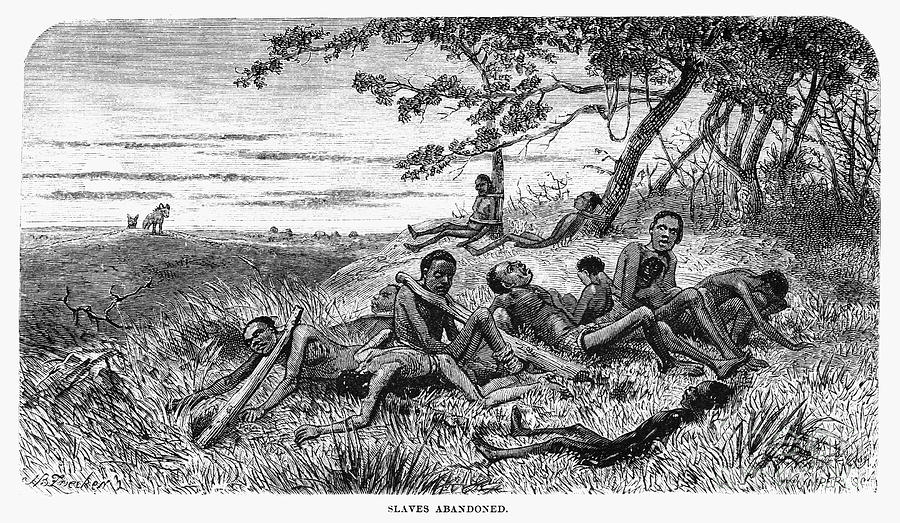
The circumstances were under which housed the slaves aboard the ships and transports were horribly: On sometimes five, sometimes temporarily stowed between decks, they lay on the bare wooden planks. The decks were built on each other so closely, often only meters distance, that was impossible to stand upright. For men, women, boys and girls there were separate departments. The two men were with iron fetters each chained together. Thus, the pent-like animals at least were able to relieve themselves standing on the decks of some wood or metal buckets, depending on my mood and were carefully emptied the team more or less regularly. The "trip" lasted for slaves - including wait times at ports - up to three months. In good weather they were taken to forced on deck where they can drum (or whip) proposals were to dance - because they were supposed to remain mobile. Many used this opportunity to jump overboard, because they preferred death in the sea, the never-ending suffering in the bowels of the ship.

DURING THE CROSSING DIED ABOUT 30 PERCENT OF THE SLAVES

Some figures say more than many descriptions: According to the official (English) calculation was allowed to take the slave ship "Brookes" with a length of 30 meters, maximum width of 7.5 and 482 slaves on board (in fact there were mostly on the 600). Of this was for a male slave sized room 1.80 * 0.40 m, for a woman to 1.50 * 0.40 m. For a guy were calculated 1.50 * 0.35 m, for a girl 1.35 * 0.30 m. That died under these conditions during the crossing often thirty percent of the slaves from fever, dysentery, malnutrition and many other reasons, was not unusual. - However, for each lost slave trader meant economic losses, sat down over the years by those masters, the slaves (and crew) and better dealt with by the lowered mortality.

The triangular trade was was essentially a business of large European seafaring nations, but also the Germans involved in human trafficking: At the behest of the Brandenburg Elector Friedrich Wilhelm I was a squad of soldiers on 1 Tres Puntos in January 1683 at the Cape in what is now Ghana, on land and built a trading fort. The fort was nothing more than a kennel, which bought up the local merchants on the coast of slaves prior to transfer to overseas prison. On the right shoulder to them, the four letters "CABC" burned (Electoral Brandenburg African-Companie) were. Overall, the Brandenburg were directly responsible for the sale of approximately 30,000 Africans to the Americas. But because the profits were not expected to be high, the German interest lasted not long. Already sold in 1721, the Prussian King Friedrich Wilhelm I, the trade continued, "Large Fredericksburg" to the Dutch.

As in Europe in the 17th Century, the coffee drinks, tea and cocoa have been popular, it was the sugar industry a huge boost because without sugar, so it was thought that all three would barely edible. The growth rates of glucose production increased exponentially now, the European palate would be spoiled. In Jamaica, began to develop huge monocultures, in 1783 there were 100 plantations, for example. On each of these worked about 500 slaves.

ALMOST ALL THE SUGAR THAT WAS CONSUMED IN EUROPE CAME FROM SLAVE LABOR

Around the year 1800 was as good as each gram of sugar that was consumed in England, cultivated by slaves and produced. The English population was about this time around 9 million, and the sugar consumption was at least 17 pounds per capita per year, equivalent to a total consumption of over 70 000 tonnes. "Since that year, the equivalent of a black man just two tons (sugar, dA), was equivalent to the total consumption of over 35 000 black slaves that were worn in the islands. Or otherwise. For every 250 Englishmen every year ... had let a black man his life "(H. Hobhouse) - With the other sugar-importing nations have behaved much differently, of course not.

In 1789 the French Revolution was under the motto "Liberty - Equality - Fraternity", 1783, the Americans fought for independence from England. The U.S. Constitution, which in many respects most advanced of its time, guaranteed to every citizen the right to "personal happiness". In many countries of Europe there was now striving for emancipation and against state authorities, and the voices multiplied, that something like slavery with the modern thinking is to not agree more.

TRENDS TOWARDS THE ABOLITION OF THE SLAVE SYSTEM

However, it took decades to what was presented in European parliaments in lofty speeches in the distant colonies came into play. England abolished slavery, for example, officially launched on 1 August 1834 with a five-year "apprenticeship" for the former slaves who were then free and independent citizens. France also needed by the year 1830, to struggle through to the abolition of the slave system. The last legal slaves transported to Brazil took place in 1854, and until 1870 the slaves were free in the Spanish colonies. The United States had U.S. citizens banned in 1800 the slave trade, yet it should - just as the Caribbean and South American slave system began to disintegrate - of all Americans to be those pioneers of democracy, a new breeding ground for the last slave-owning society of modern times prepared: the cotton fields of the southern United States.

By 1750, the manufacture of cotton cloth more complicated and thus more expensive than that of silk. The onset of industrial revolution in England, then changed to a great extent the textile industry. The use of automatic processing of the finished yarn cotton fabric was much cheaper. What was missing was the cotton wool. As the sugar, they also came from the New World, this time from the southern United States, more precisely, from North and South Carolina, Georgia, Alabama, Louisiana and Mississippi.

AFTER THE SUGAR WAS THE COTTON

Beginning of the 19th Century exploded cotton exports from the U.S. to Europe: 1830 there were 100 million pounds in 1840 already 800 million and 1850 more than 2 billion pounds. At the same eight-fold in 1784-1861, the number of black slaves in North America - at the end of 4 million. To meet demand, the cotton fields had to be increased constantly. Per hundred acres of new cotton land was needed while 10 to 20 new slaves. But the supply was a problem. The U.S. itself had banned the slave trade with third countries, the domestic trade in 1800 and 1807th The port cities of Savannah, Ga. and Charleston, South Carolina, developed the transit point for illegally smuggled from South America and the Caribbean slaves. But that was not enough, and so arose, especially in the states of Virginia, North and South Carolina and Maryland, a final, perverse business of human goods: the "slave breeding", and if you made sure, the calculation of the dealers that each a slave plantation ever enough "suitable for breeding producers" were available, were 25 to 40 percent of women "produce" a baby a year. - Were allowed to marry the other hand, slaves and monogamous life, was only at 10 to 15 percent can be expected with young ...

This system with its inhuman excesses were in the second half of the 19th Century simply no longer tenable, the one on moral grounds, on the other, but also for economic, for long has been questioned by investors in the cotton business, that the slave economy was actually more efficient than wage labor.
THE "OWNER" DID NOT WANT "THEIR" SLAVES TO SHARE SO EASILY

But slaves represented material values ​​for their owners, without compensation to which they do not want: The estimated "value" of all slaves in North America was 1850 more than 2 billion gold dollars, which met at that time about ten times the budget of the United States. The problem was not to bring per stroke of the pen from the table. The North American States advocated for many decades for the final abolition of slavery, the stubborn, cotton-producing south, but wanted to hold on to it at all costs. The issue of slavery was one of the main reasons for the American Civil War, which began 1861st After four years of carnage was dominated by the superior in all areas north.

This was the end of the last great slave-owning society. - The cultivation of cotton, however, went on after the war, with record crops - produced by free workers. [Armin Fischer, mare, Transatlantic, April 1997]

Wednesday, 3 April 2013

Brazil: Sanitation for All


As reported by Inter Press Service, "Brazil: Sanitation for All...in 115 Years," by Fabiana Frayssinet, Dec 3 , 2007 (IPS) --RIO DE JANEIRO - Just 47 percent of the population of Brazil is hooked up to the main sewage system, and at the current rate of public spending on sanitation, universal coverage will be reached when the country celebrates its 300th anniversary of independence, in the year 2122.

That warning was issued by the Instituto Trata Brasil (ITB), a non-governmental group that seeks to mobilise different segments of society in order to achieve universal sanitation in this country of 188 million people.

A study published by the ITB last week shows that Brazil’s sewage network has expanded at a slower pace than services like piped water, garbage collection, and electricity.


But the lower the investment in sanitation, the higher the mortality among children under six, which is especially high in areas where there is no sewage system, says the study by researcher Marcelo Neri.

Illnesses related to the lack of sanitation have caused around 700,000 hospital admissions a year in Brazil over the past decade, ITB president Luis Felli told IPS.

The Getulio Vargas Foundation carried out the study at the request of the ITB, which has the support of the private sector.


Felli said the lack of sanitation services is not only reflected in health statistics, but also affects education: 34 percent of missed days of school among children up to the age of six attending preschool or kindergarten are due to diarrhea or other ailments linked to a lack of sanitation or clean water.

Every day seven children under the age of five die of diarrhea in Brazil. "That is more than 200 deaths a month, the equivalent of one airplane full of children crashing every month in Brazil," said Felli.

The ITB estimates that for every real (equivalent to 57 cents of a dollar) invested in sanitation, 2.28 dollars could be saved in health spending.


And more sanitation also means a reduction in costs overall, since the creation of basic infrastructure would draw in new businesses and industries, which would generate jobs and income, said Felli.

He said that every 57 million dollars spent on sanitation works would generate 30 direct jobs and 20 indirect jobs, as well as permanent jobs once the system began operating.

With an investment of 6.2 billion dollars a year, which is what experts in sanitation say is needed, 550,000 new jobs would be created.

Sewage treatment solutions can sometimes be more simple and less costly than people think, Dr. Carlos Graeff, a specialist in infectious diseases in the southern Brazilian state of Rio Grande do Sul, told IPS.


Graeff, a professor at the Pontificia Universidade Católica in Porto Alegre and the president of the Brazilian Society for Parasitology, mentioned the example of an ingenious small-scale treatment system created by a biologist in the southern state of Santa Catarina that cleans sewage up to 80 percent by using three tanks with filters that are connected by pipes.

The communities in the Jacuí Delta, an area of swamps, canals and 16 islands formed where several rivers flow into Lake Guaiba, in Rio Grande do Sul, are attempting to acquire the treatment system through a cooperative in order to remedy the problem of pollution in the delta.

But they have not yet been able to obtain government funding, lamented Graeff, who said the islanders are worried about the spread of schistosomiasis, a parasitic disease caused by several species of flatworm carried by freshwater snails.


Although the people living in the delta - which is a nature reserve - are extremely poor, over the past three decades they have pioneered a garbage collection and treatment system. This shows that if local communities organise around an issue, inexpensive local solutions to the enormous problem of sanitation can be found, said Graeff.

The ITB study was released just before the start of 2008, which the United Nations has declared the International Year of Sanitation.

Among the eight Millennium Development Goals (MDGs) adopted by the U.N. member countries in 2000 is the goal to halve the proportion of people without sustainable access to safe drinking water and basic sanitation by 2015.  [source: Inter Press Service]

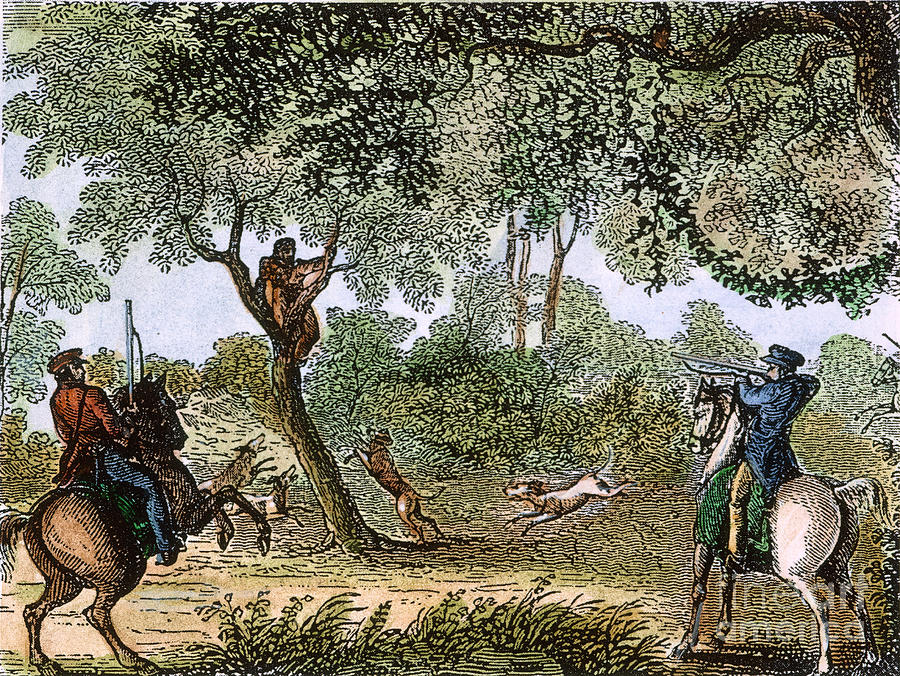
Fila Brasileiro Dog or Slave-hunter


Other evidence of 19th century just as surprising , the origins of the Fila Brasileiro . Here's the primary use of this dog out of the ordinary ... Lithograph of the dog that I think looks very close to the Fila Brasileiro current.

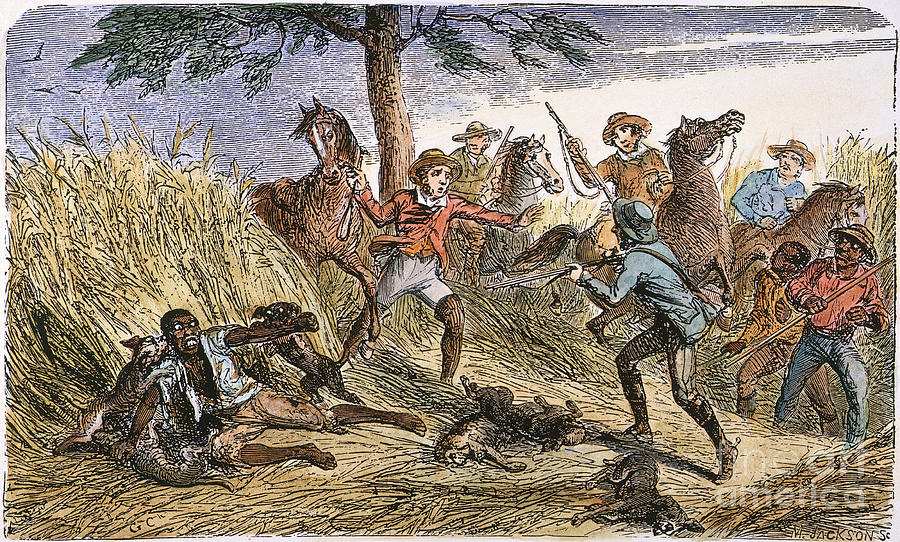
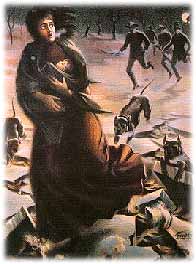
... This is a mastiff breed, crossed with the bloods hounds is due the origin of these horrible dogs of slave countries of America , the United Etas , Cuba, Brazil, they serve to hunt the negro maroon. I attended, on a plantation in Louisiana , the area of Baton Rouge , in an expedition like this, and JJE said seriously that if I did not have regard to the hospitality of the planter -Fairfax Lodge , I would be ambushed at the corner of a wood where we were looking for two "brown" and that I had made ​​good double shot on two monsters to four feet of the runway who were unhappy blacks.

I would just add that again - eighteen times out of twenty - dogs slaves returning empty handed at the kennel. [Extract from the book History of dogs of all breeds, Benedict Henry Révoil , 1867, page 115]

Slave Life in Rio


Slave Auction, Rio de Janeiro, 1859-1861

Standing on a chair, the auctioneer dominates the scene while an enslaved woman with a child clinging to her arm is examined by a prospective buyer. Other Afro-Brazilians (slaves?) are also shown; various material goods, including household furniture and musical instruments, are apparently being sold at the same auction (see also Biard05). Biard, a French painter, lived in Brazil for two years, 1859-1861. His published account contains a number of images of slave life...


Returning from a Slave Sale, Rio de Janeiro, 1859-1861

The slave owner, leading his horse while smoking a cigar and carrying an umbrella, heads a group of four adults and one child. One of the men carries household goods, including a clock and a musical instrument while the two women, one holding onto a child, are behind; bringing up the rear is an enslaved (?) man who appears to be guarding the newly-bought slaves. The material goods shown suggest that the auction was not only for the purchase of slaves but household items as well (see also Biard04). Biard, a French painter, lived in Brazil for two years, 1859-1861.

Cotton and the Civil War


From Mississippi History Now, "Cotton and the Civil War," by Eugene R. Dattel, on July 2008--  If slavery was the corner stone of the Confederacy, cotton was its foundation. At home its social and economic institutions rested upon cotton; abroad its diplomacy centered around the well-known dependence of Europe…upon an uninterrupted supply of cotton from the southern states. (Frank L. Owsley Jr.)


On the eve of the American Civil War in the mid-1800s cotton was America’s leading export, and raw cotton was essential for the economy of Europe. The cotton industry was one of the world’s largest industries, and most of the world supply of cotton came from the American South. This industry, fueled by the labor of slaves on plantations, generated huge sums of money for the United States and influenced the nation’s ability to borrow money in a global market. In many respects, cotton’s financial and political influence in the 19th century can be compared to that of the oil industry in the early 21st century.

Mississippi, the nation’s largest cotton-producing state, was economically and politically dependent on cotton, as was the entire South. Indeed, it was the South’s economic backbone. When the southern states seceded from the United States to form the Confederate States of America in 1861, they used cotton to provide revenue for its government, arms for its military, and the economic power for a diplomatic strategy for the fledgling Confederate nation.

King Cotton diplomacy

The diplomatic strategy was designed to coerce Great Britain, the most powerful nation in the world, into an alliance with the Confederacy by cutting off the supply of cotton, Britain’s essential raw material for its dominant textile industry. Before the American Civil War, cotton produced in the American South had accounted for 77 percent of the 800 million pounds of cotton used in Great Britain. After Britain had officially declared its neutrality in the American war in May 1861, the president of the Confederacy, Jefferson Davis – a Mississippi planter, Secretary of War under U.S. President Franklin Pierce, and former U. S. senator – strongly supported what became known as King Cotton diplomacy. Confederate leaders believed an informal embargo on cotton would lead Great Britain into formal recognition of the Confederacy and to diplomatic intervention with other European countries on behalf of the South.


Confederate Cotton Burners

To begin King Cotton diplomacy, some 2.5 million bales of cotton were burned in the South to create a cotton shortage. Indeed, the number of southern cotton bales exported to Europe dropped from 3 million bales in 1860 to mere thousands. The South, however, had made a pivotal miscalculation. Southern states had exported bumper crops throughout the late 1850s and in 1860, and as a result, Great Britain had a surplus of cotton. Too, apprehension over a possible conflict in America had caused the British to accumulate an inventory of one million bales of cotton prior to the Civil War. The cotton surplus delayed the “cotton famine” and the crippling of the British textile industry until late 1862. But when the cotton famine did come, it quickly transformed the global economy. The price of cotton soared from 10 cents a pound in 1860 to $1.89 a pound in 1863-1864. Meanwhile, the British had turned to other countries that could supply cotton, such as India, Egypt, and Brazil, and had urged them to increase their cotton production. Although the cotton embargo failed, Britain would become an economic trading partner.


Confederate Cotton Fortifications

Weapons, ammunition and ships

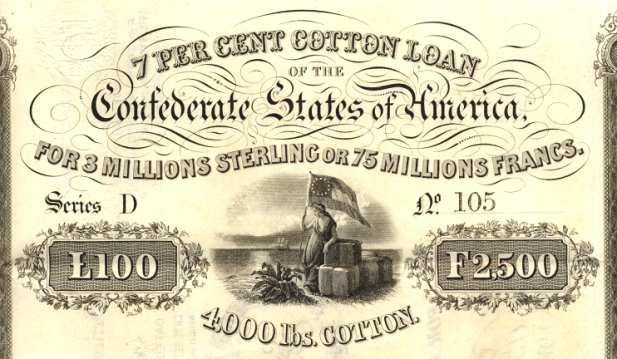
The failure of King Cotton diplomacy was merely a tactical blunder with no reflection on the power of cotton. The imaginative and brilliant financing of the cotton-backed Erlanger bond, launched in Europe in March 1863, epitomized the potential of cotton credit. The Erlanger bond, named after the powerful French banking house Erlanger & Cie., was a dual currency, one commodity bond. Through it the Confederate States of America attempted to borrow 3 million pound sterling or 75 million French francs for 20 years, priced at 7 percent. Investors could receive coupon and principal payments in either pound sterling or French francs, and were given the additional option of taking payment in cotton at a fixed price. The high-risk Erlanger bond was oversubscribed, and the price fell within a few months. The Erlanger bond quickly became one of history’s most important junk bonds.


Nonetheless, the Confederacy was able to use cotton as a bartering tool to fund the purchase of weapons, ammunition, and ships from British manufacturers. The transport of the armaments to the Confederacy was made possible by the lucrative cotton trade that tempted blockade-runners to pierce the Union blockade for potential profits of 300 percent to 500 percent per voyage. U.S. President Abraham Lincoln had declared a naval blockade on the Confederacy in April 1861 to prevent its shipments of cotton to European powers. The blockade covered the seaports along the southern Atlantic coast below Washington, D.C., and extended along the Gulf coast to the Mexican border. The blockade-runners would offload cotton at the British islands of Nassau and Bermuda off the Confederate coast in exchange for armaments. Although the Union increased its number of blockaders, especially steam vessels, their effectiveness was hampered by the lack of coal and maintenance problems. It was the Union capture of southern ports, more than the blockade, that reduced the Confederate cotton-armaments trade. The last port, Wilmington, North Carolina, was taken in January 1865.

Lieutenant Colonel J. W. Mallet, a Confederate ordnance officer, praised the armaments supplied through the blockade with “cotton in payment” as “being of incalculable value.” At the Battle of Shiloh, Confederate troops used weaponry and supplies conveyed from Great Britain by the blockade-runner Fingal. During the war, an estimated 600,000 “pieces of equipment” were supplied by the British. In his memoirs, Union General Ulysses S. Grant acknowledged the superiority of the British rifles that his forces had captured at the siege of Vicksburg. The rifles, he wrote, had “run the blockade.” British-built war ships, most notably the C.S.S. Alabama, destroyed much of the Northern merchant marine. Cotton had financed the construction of the war ships.


Loading Bales of Cotton, Pensacola, Florida

The lure of cotton

Cotton also spawned a series of federal regulations during the war. The North needed cotton for its textile mills, and it wanted to deprive the South of its financing power. Therefore, federal permits issued by the Treasury Department were required to purchase cotton in the Confederate states. The system was rife with corruption, particularly in the Mississippi Valley. Confederate cotton that was subject to confiscation by the North could not be distinguished from legitimate cotton grown by planters loyal to the Union. Cotton could be purchased for as little as 12 to 20 cents a pound, transported to New York for 4 cents a pound, and sold for up to $1.89 a pound. One observer noted that the “mania for sudden fortunes in cotton” meant that “Every [Union] colonel, captain, or quartermaster is in secret partnership with some operator in cotton.” The lure of cotton wealth would entice white Northern civilians and Union soldiers south during and after the war.

The future of former slaves remained sealed in the cotton fields. Blacks were denied economic and physical mobility by federal government policy, by the racial animosity of Northern whites, and by the enduring need for cotton labor in the South. The federal government was forced to confront the question of what to do with slave refugees and those who had escaped behind Union lines. In 1863 Union Adjutant General Lorenzo Thomas in the Mississippi Valley devised a solution, a form of containment policy, whereby freed slaves would remain in the South. They would be used in the military service, or “placed on the abandoned [cotton] plantations to till the ground.” Former slaves were to be contracted to work on the abandoned plantations – many around Vicksburg. Labor guidelines, such as $10 a month pay and a 10-hour day, were posted. If a laborer missed two hours of work a day, he lost one-half of his day’s pay. The former slaves were not allowed to leave the plantation without a pass. The white Northern lessees of the plantations were generally driven by money. As many as two-thirds of the labor force was thought to have been “defrauded of their wages in 1864.”

World’s leading cotton exporter

After the war ended in 1865, the future of cotton land remained under white southern control. Northern Republican businessmen were firmly opposed to confiscation of lands from southern plantation owners and actively supported the resumption of cotton production by means of large plantations under the management of landowners.


Cotton Bales

Therefore, the stage for Reconstruction was set. The economic importance of cotton had not diminished after the war. In fact, the federal government and northern capitalists were well aware that restoration of cotton production was critical to the financial recovery of the nation. Cotton exports were needed to help reduce the huge federal debt and to stabilize monetary affairs in order to fund economic development, particularly railroads.

America regained its sought-after position as the world’s leading producer of cotton. By 1870, sharecroppers, small farmers, and plantation owners in the American south had produced more cotton than they had in 1860, and by 1880, they exported more cotton than they had in 1860. For 134 years, from 1803 to 1937, America was the world’s leading cotton exporter.

Historian Harold D. Woodman summarized the stature of cotton, “If the war had proved that King Cotton’s power was far from absolute, it did not topple him from his throne, and many found it advantageous to serve him.”  [source: Eugene R. Dattel is an economic historian, and the author of a previous article for Mississippi History Now, Cotton in a Global Economy: Mississippi, 1800-1860.]

Charles Sumner on the Barbarism of Slavery


From the New York Times, "FROM WASHINGTON.; Charles Sumner on the Barbarism of Slavery. The Social Tendencies of the Institution Argued. Bitter Reply of a South Carolina Senator. The House on Post-office Business and Public Printing. FROM WASHINGTON, Published: June 5, 1860."

If this picture of the relations of slave-masters with their slaves could receive any further darkness, it would be by introducing the figures of the congenial agents through which the barbarism is maintained; the slave overseer, the slave breeder, and slave hunter, each without a peer except in his brother, and the whole constituting the triumvirate of Slavery, in whom its essential brutality, vulgarity, and grossness, are all embodied. There is the slave overseer, with, his bloody lash, fitly described in his Life of Patrick Henry by Mr. WIRT, who born in Virginia, knew the class, as "last and lowest, most abject, degraded, unprincipled," and his hands wield at will the irresponsible power. There is the slave breeder, who assumes a higher character, and even enters legislative halls, where, in unconscious insensibility, he shocks civilization by denying, like Mr. GHOLSON, of Virginia, any alleged distinction between the "female slave" and "the brood mare," by openly asserting the necessary respite from work during the gestation of the female slave as the ground of property in her offspring, and by proclaiming that in this "vigintial" crop of human flesh consists much of the wealth of his State, while another Virginian, not yet hardened to this debasing trade, whose annual sacrifice reaches 25,000 human souls, confesses the indignation and shame with which he beholds his State "converted into one grand menagerie, where men are reared for the market like oxen for the shambles," and lastly there is the slave-hunter, with the blood-hound as his brutal symbol, who pursues slaves as the hunter pursues game, and does not hesitate in the public prints to advertise his barbarism thus:

BLOOD-HOUNDS. -- I have two of the finest dogs for catching negroes in the Southwest. They can take the trail twelve hours alter the negro has passed and catch him with case. I live four miles southwest of Bolivar, on the road leading from Bolivar to Whitesville. I am ready at all times to catch runaway negroes. DAVID TURNER.  --  MARCH 2, 1853. -- West Tennessee Democrat.
The bloodhound was known in early Scottish history. It was once vindictively put upon the trail of ROBERT BRUCE; and in barbarous days, by a cruel license of war, it was directed against the marauders of the Scottish border; but more than a century has passed since the last survivor of the race, kept as a curiosity was fed on meal in Ettrick Forest. (SCOTT's Lay of the Last Minstrel -- Notes, Canto V.) The bloodhound was employed by Spain against the natives of this continent, and the eloquence of CHATHAM never touched a truer chord than when, gathering force from the condemnation of this brutality, he poured his thunder upon the kindred brutality of the scalping-knife, adopted as an instrument of war by a nation professing civilization. Tardily introduced int, our Republic, some time after the Missouri Compromise, when Slavery became a political passion, and slave masters began to throw aside all disguise, the blood-hound has become the representative of our barbarism in one of the worst forms, when engaged in the pursuit of a fellow man who is asserting his inborn title to himself; and this brute is, indeed, typical of the whole brutal leash of slave-hunters, who, whether at home on slave soil, under the name of slave-catchers and kidnappers, or at a distance, under politer names, insult human nature by the enforcement of this barbarism.


3. From this dreary picture of slave masters, with their slaves and their triumvirate of vulgar instruments, I pass to another more dreary still, and more completely exposing the influence of Slavery; I mean the relations of slave masters with each other, also with society and Government, or in other words, the character of slave masters, as displayed in the general relations of life. And here I need your indulgence. Not in triumph or in taunt do I approach this branch of the subject. Yielding only to the irresistible exigency of the discussion, and in direct response to the assumptions on this floor, especially by the Senator from Virginia (Mr. MASON.) I shall proceed. If I touch slavery to the quick, and enable slave masters to see themselves as others see them, I shall do nothing beyond the strictest line of duty in this debate. One of the choicest passages of the master Italian poet DANTE is where a scene of transcendent virtue is described as sculptured in "visible speech" on the long gallery which led to the heavenly gate. The poet felt the inspiration of the scene, and placed it on the wayside, where it could charm and encourage. This was natural. Nobody can look upon virtue and justice, if it be only in images and pictures, without feeling a kindred sentiment. 


Nobody can be surrounded by vice and wrong, by violence and brutality, if it be only in images and pictures, without coming under their degrading influence. Nobody can live with the one without advantage; nobody can live with the other without loss. Who could pass his life in the secret chamber where are gathered the impure relics of Pom[???] without becoming indifferent to loathsome things? But if these loathsome thing are not merely sculptured and painted if they exist in living reality -- if they enact their hideous capers in life, as in the criminal pretensions of Slavery -- while the lash plays and the blood spirts -- while women are whipped and children are sold -- while marriage is polluted and annulled -- while the parental tie is rudely torn -- while honest gains are filched or robbed -- while the soul itself is shut down in all the darkness of ignorance, and while the God himself is defied in the pretension that man can have property in his fellow man; if all these thing are present, not merely in images and pictures but in reality, their influence on character must be incalculable. It is according to irresistible law that men are fashioned by what is about them, whether climate, scenery, life or institutions. Like produces like, and this ancient proverb is verified always. 

Look at the miner, delving low down in darkness, and the mountaineer, ranging on airy heights, and you will see a contrast in character, and even in personal form. The difference between a coward and a hero may be traced in the atmosphere which each has breathed; and how much more in the institutions under which each has been reared. If institutions generous and just ripen souls also generous and just, then other institutions must exhibit their influence also. Violence, brutality; injustice barbarism, must be reproduced in the lives of all who live within their fatal sphere. The meat that is eaten by man enters into and becomes a part of his body; the madder which is eaten by a dog changes his bones to red; and the Slavery on which men live, in all its five fold foulness, must become a part of themselves, discoloring their very souls, blotting their characters, and breaking forth in moral leprosy. This language is strong; but the evidence is even stronger. Some there may be of happy natures -- like honorable Senators -- who can thus feel and not be harmed. MITHRIDATES fed on poison and lived; and it may be that there is a moral Mithridates, who can swallow without bane the poison of Slavery. Instead of "ennobling" the master, nothing can be clearer than that the slave drags his master down; and this process begins in childhood and is continued through life. Living much in association with his slave, the master finds nothing to remind him of his own deficiencies, to prompt his ambition or excite his shame. Without these provocations to virtue, and without an elevated example, he naturally shares the barbarism of the society which he keeps. Thus, the very inferiority which the slave-master attributes to the African race explains the melancholy condition of the communities in which his degradation is declared by law. (source: The New York Times)

Monday, 1 April 2013

The Brazilian Law of Sexagenarians: Slaves Over The Age of 60

http://www.historiabrasileira.com/files/2010/05/lei-dos-sexagenarios.jpg


As translated from History of Brazil, "Lei dos Sexagenários," by Antonio Junior Gasparetto, on 5 March 2010 -- The Law of the sixties gave freedom to slaves aged over 65 years. Represented another onslaught of the abolitionists toward the final end of slavery in the country.

In the mid-nineteenth century Brazil started to enact laws that aimed to end the use of slave labor in the country. As a result of pressure from England, which in 1845 enacted a law Bill Aberdeen, Brazil enacted Law Eusebio de Queiroz in 1850 banning the slave trade in the Atlantic Ocean. The move caused an initial shock and caused growers arrumassem other methods to acquire their slave laborers. In the years following what happened in Brazil was an intensification of the domestic slave trade, the core of higher concentration of hand labor involved compulsory São Paulo, Minas Gerais and Rio de Janeiro, the three main provinces coffee.

https://blogger.googleusercontent.com/img/b/R29vZ2xl/AVvXsEi1rqzOIPv1wLo3ZPaDmtlm1hIvcnI9Xe6g3wgWo89Itb88mf_cQhdAbd6IlCbNPmeRJXZ2H_inzBbRRYiVTQcOfgtcJ50DPNN8OBSeEdSaf-eQxSmdqnhCVF1lPx2yygUvhLhH8UFvHXPw/s400/220px-Escravo_brasileiro_1865.jpg

Although there were many supporters of abolitionism, only two decades after a new law was passed in favor of the slaves. In 1872 the parliament passed the Law of the Free Womb, which gave freedom to the children of slaves born from the date of its approval. In practice this measure does not solve the problem of slave labor, because until the individual reaches the age of 21 years at the time was the farmer who cared for him. Thus, the freed slave and ended up doing when reached his majority was indebted to the farmer, having to provide services without pay for many more years to pay off their debts.

The following years marked an intensification of the speech and the Republican abolitionist. Already in the 1880s the internal and external pressure was too great for Brazil to determine the order of slave labor. In 1884 the liberal Sousa Dantas introduced a bill advocating freedom for slaves aged 60 years or more. The project was highly debated in Parliament, on the one hand, the abolitionists remained steady for another conquest, and on the other hand, the slave responded with force. Like most sexagenarian was coffee in the provinces, the slave protested against the law. Farmers, individuals of great influence in the period, could the law was passed only in 1885 and with an addendum favorable. The Law of the sixties, also called the Law Saraiva-Cotegipe, took that name because initial project consisted in the liberation of the slaves with 60 years or more, only that coffee growers succeeded in raising the age to 65 years of freedom.

http://www.portalsaofrancisco.com.br/alfa/escravidao-no-brasil/imagens/lei-do-sexagenarios-1.jpg

The Law of the sixties, which was enacted on September 28, 1885, did not have much practical effect, because slaves with such age were not as valued. It was also very difficult that slaves were able to live under the conditions imposed to reach this age. Just as the Law of the Free Womb, Law of sexagenarians granted freedom to another installment of slaves, but the practical application of both was irrelevant, keeping the country marked by its base slave. (source translated: http://www.historiabrasileira.com/escravidao-no-brasil/lei-dos-sexagenarios/)
http://pt.wikipedia.org/wiki/Lei_dos_Sexagenários

Saturday, 30 March 2013

Jesus Was Lynched

As reported by Truthdig, "Jesus Was Lynched," by Mel White, on 23 December 2011 -- For more than 40 years I’ve been moved and provoked by the writings of James Cone, Union Seminary’s distinguished professor of systematic theology. While reading his newest book, “The Cross and the Lynching Tree,” however, I felt grief and anger on a whole new scale. I felt grief for the nearly 5,000 African-American men, women and children who were lynched between 1880 and 1940, and anger that during that 60-year holocaust, white preachers, evangelists and theologians didn’t even notice. No author has ever made me more ashamed to be a white American Christian and at the same time no author has ever given me a more dramatic example of the sustaining power of the cross.

All my life I had been taught that the cross was at the heart of my Christian faith. It has been a long time since I was deeply moved by it. “The Cross and the Lynching Tree” helped me experience the cross on a far more visceral level. Cone says it simply: Jesus was lynched. He makes the connection between the crucifixion of Jesus and the lynching of African-Americans. He explains why understanding that connection is vital to understanding the meaning of the cross:

https://blogger.googleusercontent.com/img/b/R29vZ2xl/AVvXsEhU7MhA6t_9xqEU6S0iq4WWf0QSv1xIQDwO6mc1W7Gbvlllvz5zrC8FdTTHPRLiNHEYcHhrMfeulFkqCdtCGwzwnnQLeKft0vx78flNEjGooPUirKf59sHLhWO-FwjjHaiqMdB0uMEmnhw/s400/Lynch+Mob.jpg

“As Jesus was an innocent victim of mob hysteria and Roman imperial violence, many African-Americans were innocent victims of white mobs, thirsting for blood in the name of God and in defense of segregation, white supremacy, and the purity of the Anglo-Saxon race. Both the cross and the lynching tree were symbols of terror, instruments of torture and execution, reserved primarily for slaves, criminals, and insurrectionists—the lowest of the low in society. Both Jesus and blacks were publicly humiliated, subjected to the utmost indignity and cruelty. They were stripped, in order to be deprived of dignity, then paraded, mocked and whipped, pierced, derided and spat upon, and tortured for hours in the presence of jeering crowds for popular entertainment. In both cases, the purpose was to strike terror in the subject community. It was to let people know that the same thing would happen to them if they did not stay in their place.”

During his decades of research, Cone found, incredibly, no sermons, lectures, books or articles by white preachers, evangelists or theologians linking what happened on the cross to what happened on the lynching tree—not even when lynching was at its peak.

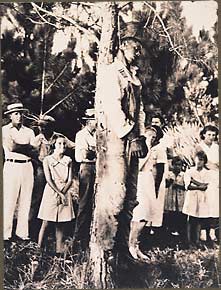
http://www.blackyouthproject.com/wp-content/uploads/2011/02/RubinStacyLynching1.jpg

Cone is particularly saddened that Reinhold Niebuhr, perhaps the most influential theologian and ethicist of the 20th century, “failed to connect the cross and its most vivid reenactment in his time.” Cone, who is black and grew up in segregated Arkansas, is rightfully aggrieved when he describes the silence of Christian leaders during and after the lynching years. “To reflect on this failure,” Cone warns, “is to address a defect in the conscience of white Christians and to suggest why African-Americans have needed to trust and cultivate their own theological imagination.”

Story after heartbreaking story, Cone walks us through those tragic and shameful years when thousands of black Americans were dragged from their homes and families, raped, tortured, disemboweled, castrated, burned and/or hanged by white Americans. Often those same white Americans were quoting Scripture while silhouetted by flaming crosses. Here are just two of the stories Cone tells to illustrate the horror of the lynching tree:

https://blogger.googleusercontent.com/img/b/R29vZ2xl/AVvXsEjKrFaTUpT923fUV97f6_DpypYtcczvgXcnTYhLkU40-c2MbBlLmXlYFiFrKZ8dAPLWQ3arMX7enfvCbu65Fli60npUZqyiLyeCWCjMryhyphenhyphenaN5GUrHu2HEx5kW6zPCyZhp-5uQtV9ZUpOc/s320/lynched_black_woman%5B1%5D.jpg

AsIn 1918, when a white mob in Valdosta, Ga., couldn’t find Haynes Turner (who was guilty of nothing more than being black) the sheriff arrested his wife instead. Mary Turner was eight months pregnant. When she insisted that her husband was innocent, she was “stripped, hung upside down by the ankles, soaked with gasoline and roasted to death. In the midst of this torment, a white man opened her swollen belly with a hunting knife and her infant fell to the ground and was stomped to death.”

In 1955, Emmett Louis “Bo” Till, a 14-year-old African-American from Chicago, was kidnapped from his grandparents’ Mississippi home because (or so the rumor went) he had dared to whistle at Carolyn Bryant, a 21-year old white woman, and moments later said “Bye, baby” as she left a local store. At 2 a.m. Bryant’s husband and his half-brother dragged Till to a barn where one of the boy’s eyes was gouged out. He was tortured, beaten beyond recognition, shot in the head, tied to a heavy gin fan and dropped into the Tallahatchie River. The two men were arrested, tried and found not guilty of the crime.

https://blogger.googleusercontent.com/img/b/R29vZ2xl/AVvXsEi-iYkPIFCaY6XdoAf4wf-eywxJqNeGN5ml5xIXW5gGG9MyozYo8DwOyFuMxOg5cmBFvQwPMI5__dEjWfGg6kfdJu47_f3KoflQRmbHG4HFBO-XBkvWfOlULjAoLozb0MN2nQNMfrq2ULUA/s1600/lynchinglg+waco2a.jpg

Cone documents in grim detail the unimaginable mental and physical suffering black Americans experienced during those lynching years. But instead of giving up on God, those who suffered embraced their Christian faith with new zeal. Cone turns to Dr. Martin Luther King Jr. to help us understand how great suffering, paradoxically, can lead to even greater faith. In his “darkest hours” during the Montgomery bus boycott, King’s own experience of suffering lead him to conclude that we do not know what we truly believe or what our theology is worth until “our highest hopes are turned into shambles of despair” or “we are victims of some tragic injustice and some terrible exploitation.” Cone summarizes the mystery of faith that grew stronger during the lynching years:

“Black faith emerged out of black people’s wrestling with suffering, the struggle to make sense out of their senseless situation, as they related their own predicament to similar stories in the Bible. On the one hand, faith spoke to their suffering, making it bearable, while on the other hand, suffering contradicted their faith, making it unbearable. That is the profound paradox inherent in black faith, the dialectic of doubt and trust in the search for meaning, as blacks ‘walk[ed] through the valley of the shadow of death.’ ”

“The Cross and the Lynching Tree” also explores the connection between faith and art, through the music, poetry and prose of those who suffered. Cone asks: “How did ordinary blacks, like my mother and father, survive the lynching atrocity and still keep together their families, their communities and not lose their sanity?” He answers that question simply: “Both black religion and the blues offered sources of hope that there was more to life than what one encountered daily in the white man’s world.”

http://static.ebony.com/LynchingCaro_page-bg_6238.jpg

There was no opportunity for black Americans to protest, let alone defend themselves from the violence that permeated their lives. In public, where a black man could be lynched for looking a white man in the eye, they had to play the subservient coward. But on Saturday nights, by singing the blues in the privacy of their “juke joints” where the whole community gathered to dance, drink, clap, stomp and “hollar,” these “cowards” expressed their courage and their determination to overcome. Those nights brought a measure of joy and a lot of relief to black Americans. To the white man all that “noise” must have seemed tribal and orgiastic. But if those same white men had been capable of truly listening, they would have realized that the poetry of the blues was in fact restoring the souls of black Americans and renewing their determination to resist despair.

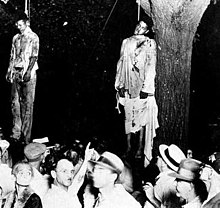
As a child, Cone remembers hearing the blues echoing at night from “Sam’s Place” near his home in Arkansas. The author recalls tapping his feet and moving his body to the sounds of B.B. King’s “Rock Me Baby” and Bo Diddley’s “I’m a Man.” There is no question, however, that Billie Holiday holds a special place for the author. In 1939, on the stage of New York’s Café Society, Holiday sang “Strange Fruit,” the first of many songs that would help mobilize the civil rights movement. Time magazine called “Strange Fruit” “the best song of the century,” and Holiday “history’s greatest jazz singer.” The song was written by Abel Meeropol, the white Jewish communist who later adopted the two sons of convicted spies Julius and Ethel Rosenberg after their execution. “Strange Fruit” was inspired by an appalling photo Meeropol saw of a lynching in Mississippi:

http://upload.wikimedia.org/wikipedia/en/thumb/7/78/ThomasShippAbramSmith.jpg/220px-ThomasShippAbramSmith.jpg

“Southern trees bear strange fruit, Blood on the leaves and blood at the root,
Black body swinging in the Southern breeze, Strange fruit hanging from the poplar trees.
Pastoral scene of the gallant South, The bulging eyes and the twisted mouth,
Scent of magnolia sweet and fresh, Then the sudden smell of burning flesh …”

On Sundays a different kind of music was heard. Cone uses the familiar spiritual “Nobody knows the trouble I’ve seen” to show how the black poetry of those lynching years reflected both suffering and certainty. The spiritual begins with a mournful lament but ends with an almost inexplicable shout of praise: “Nobody knows de trouble I’ve seen. Nobody knows my sorrow. Nobody knows de trouble I’ve seen … Glory Hallelujah!”

https://blogger.googleusercontent.com/img/b/R29vZ2xl/AVvXsEiJmFirBhHyMOiUW26o_X6VMwI2vhUfZWjN_aFz7tJpv1PTFbWyxBvgOIc4DMfbf7NCtUQBQ7EGC9l6Dr3yUpE3G9iLfZY1tgQGZF7K-J6RiPToJzI_IViyrJtud0UC26V7n3jt5J0c_74/s1600/linchamiento-18.jpg

Black poets and musicians brought hope in times of despair. They were not blind to the fact that white Christians were in large part the cause of their suffering. With scathing sarcasm, black poet Walter Everette Hawkins called lynching “A Festival of Christendom” alongside the festive days of Christmas and Easter:

“And so the Christian mob did turn from prayer to rob, to lynch and burn.
A victim helplessly he fell to tortures truly kin to hell;
They bound him fast and strung him high. They cut him down lest he should die
Before their energy was spent in torturing to their heart’s content.
They tore his flesh and broke his bones and laughed in triumph at his groans;
They chopped his fingers, clipped his ears and passed them round as souvenirs.
The bored hot irons in his side and reveled in their zeal and pride;
They cut his quivering flesh away and danced and sang as Christians may … ”

In spite of their anger at white Christians, they spoke of Jesus’ life and death with increasing reverence. Black poet Countee Cullen writes, “How Calvary in Palestine, extending down to me and mine, was but the first leaf in a line of trees on which a Man should swing … ” Cone points out that in this poem Cullen is claiming “that Christ, poetically and religiously, was symbolically the first lynchee,” and by this close association with Jesus “turned lynch victims into martyrs.” Cullen wrote, “The South is crucifying Christ again,” and this time “he’s dark of hue.” According to Cone, Cullen and many of his fellow poets and musicians could not help but see “ … the liberating power of the ‘Black Christ’ for suffering black people.”

http://www.tampabay.com/specials/2011/reports/claude-neal-lynching/report/images/lynching-photo.jpg

“Ordinary blacks” survived those lynching years, Cone says, because their Jesus too had been lynched. He too had suffered exactly as they were suffering. They were not alone when they walked into the valley of death because Jesus walked that way before them. “Jesus walked this lonesome valley,” a spiritual begins, “He had to walk it by himself. Nobody else could walk it for him. He had to walk it by himself.” African-American Christians were absolutely certain the Christ who died on a cross understood their suffering and would see them through it.

Cone understands that although black art and music helped foment the civil rights movement, “ … the blues and the juke joint did not lead to an organized political resistance against white supremacy. But one could correctly say that the spirituals and the church, with Jesus’ cross at the heart of its faith, gave birth to the black freedom movement that reached its peak in the civil rights era during the 1950s and 1960s. The spirituals were the soul of the movement, giving people courage to fight, and the church was its anchor, deepening its faith in the coming freedom for all.”

Cone makes it clear that the civil rights movement of the 1950s and 1960s—with spirituals as its soul and the church as its anchor—saw an end to segregation but not to white supremacy. At its heart, “The Cross and the Lynching Tree” is a powerful indictment of white supremacy, past and present, and a challenge to white Americans to have “the courage to confront the great sin and ongoing legacy of white supremacy with repentance and reparation.”

http://www.blackpast.org/files/blackpast_images/event_omaha_courthouse_lynching.jpg

The lynching of black Americans is still taking place in the 21st century. Cone targets America’s criminal justice system “ … where nearly one-third of black men between the ages of 18 and 28 are in prisons, jails, on parole or waiting for their day in court.” Cone continues:

“Nearly one-half of the more than 2 million people in prisons are black. That is 1 million black people behind bars, more than in colleges. Through private prisons and the ‘war against drugs’ whites have turned the brutality of their racist legal system into a profit-making venture for dying white towns and cities throughout America. … Nothing is more racist in America’s criminal justice system than its administration of the death penalty. America is the only industrialized country in the West where the death penalty is still legal. The death penalty is primarily reserved, though not exclusively, for people of color, and white supremacy shows no signs of changing it. That is why the term ‘legal lynching’ is still relevant today. One can lynch a person without a rope or tree.”

http://notmytribe.com/wp-content/uploads/2010/03/Lynching-Lige-Daniels-1920-Texas.jpg

I am a white American. What questions should I ask myself about living in a nation still permeated by white supremacy? What questions should I ask myself about living in a mostly white neighborhood, attending a mostly white church and hanging out with mostly white friends? Cone states unequivocally that Jesus calls us to confront white supremacy. “I believe,” Cone writes, “that the cross placed alongside the lynching tree can help us to see Jesus in America in a new light, and thereby empower people who claim to follow him to take a stand against white supremacy and every kind of injustice.”


“The Cross and the Lynching Tree” also transcends the topic of lynching and the suffering of African-Americans. Cone asks his readers to see all suffering and oppression in light of the promise of the cross. Therefore—and please forgive this personal aside—his “every kind of injustice” includes the injustice faced by lesbian, gay, bisexual and transgender Americans. What was Matthew Shepard’s death but a lynching? All the elements are present. Shepard was harassed, kidnapped, driven to a remote country area, robbed, pistol-whipped, tortured, tied to a fence and left to die. Brandon Teena, a 21-year-old trans man who was raped and murdered, is just one example of dozens of forgotten trans people who are lynched every year. And in some ways Tyler Clementi, Jamey Rodemeyer and all the other gay teens and young people who have committed suicide because of bullying and harassment are lynching victims.

 http://www.tampabay.com/specials/2011/reports/claude-neal-lynching/report/images/lynching-photo.jpg

My son once asked me, “How can you still be a Christian, Dad, after what the church has done to you?” Suddenly we’re back to the same mystery we encountered with black Christians during the lynching years. Cone quotes the Apostle Paul to describe this mystery: “St. Paul said that the ‘word of the cross is foolishness’ to the intellect and a ‘stumbling block’ to established religion. The cross is a paradoxical religious symbol because it inverts the world’s value system with the news that hope comes by way of defeat, that suffering and death do not have the last word, that the last shall be first and the first last.” I believed that Jesus was with me during the attacks by Bible-quoting Christians, during the disappearance of most of my old friends and clients, and during the aversive therapies, the electric shock and the exorcisms by well-meaning Christians who tried to rid me of the “demon of homosexuality.” And in my lowest moments when I genuinely longed for death, I knew that Jesus would walk with me through that valley as well.

Black Americans were victims of white Christian bigotry as gay Americans are victims of straight Christian bigotry. Please don’t think for a moment that I am comparing my suffering or the suffering of the LGBT community to the suffering of African-Americans during the lynching years. I am not. But in the struggle between faith and oppression, and sensing Jesus’ presence during my own suffering, I feel solidarity with my African-American family whose faith in the “old rugged cross” was the key to surviving the lynching tree. 

http://www.gateschili.org/webpages/cwhite/photos/14136/Large_1935_lynching_of_Rubin_Stacy_in_Fort_Lauderdale.jpg

Here is the danger: To say that Jesus stands with me in my suffering is far too simple. My redemption doesn’t come that easily. There’s something in the cross that says this is not just about my “salvation” but about the “salvation” of all those who suffer injustice and inequality. The cross warns and welcomes. It warns me that if I confront white supremacy, homophobia or injustice of any kind, I could end up being lynched. And the cross welcomes me to that great company of the committed who believed its promise that “death is not the end but the beginning of life.”

Cone reminds us that “ … it takes a special kind of imagination to understand the truth of the cross. … The Gospel of Jesus is not a rational concept to be explained in a theory of salvation, but a story about God’s presence in Jesus’ solidarity with the oppressed which led to his death on the cross. … What is redemptive is the faith that God snatches victory out of defeat, life out of death and hope out of despair, as revealed in the biblical and black proclamation of Jesus’ resurrection.”

[source: Truthdig -- The Rev. Mel White is co-founder of Soulforce and the author of “Stranger at the Gate: To Be Gay and Christian in America” and “Religion Gone Bad: The Hidden Dangers of the Christian Right.” --- © 2013 Truthdig, LLC. All rights reserved.]